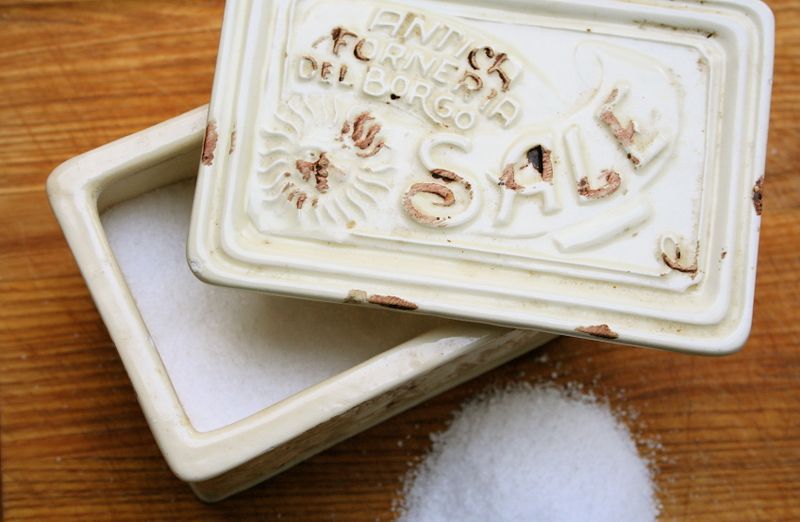
IMG_2310 A few months ago I asked my friend Kimberly if she would mind doing a guest post on my blog. You see, this friend Kimberly of mine is a graduate of the Culinary Institute of America and I have her to thank for my conversion to kosher salt about 7 years ago. I haven't bought table salt since. You see,  I'm kind of passionate about kosher salt. I'll never go back. I even bought us these matching ceramic salt boxes to house our kosher salt. Mine is always within arms reach, right next to the oven.

So without further ado, I introduce Kimberly!
IMG_2300
While all salts are technically kosher, they are not all KOSHER salt! What is the difference between table salt and kosher salt?

All salt is sodium chloride. The difference between the salt options we have in the store starts with where they were mined/harvested and ends with the refining process.

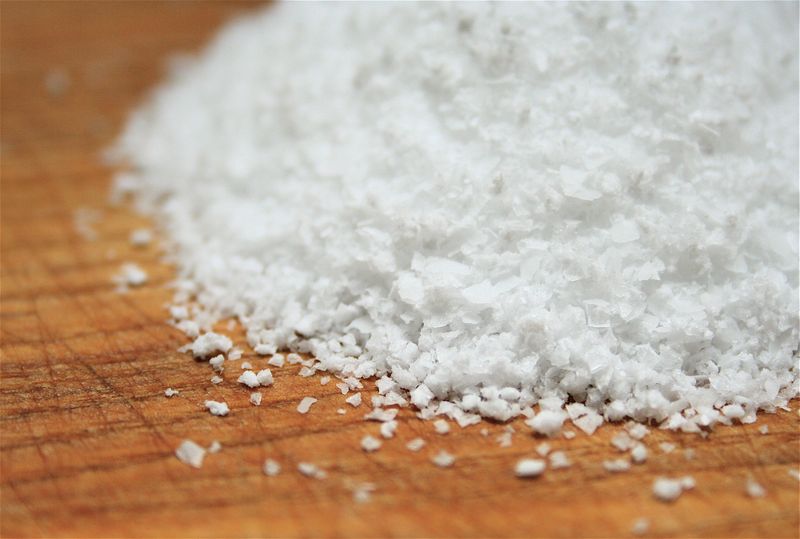
Diamond Crystal is my favorite kind of kosher salt. The sodium chloride is blown into a stainless steel box and permitted to dry and form crystals. These crystals are scraped off the box, and the process is finished. Giving you lovely large salt crystals with no additional ingredients. (Some kosher salts, like Morton’s, add sodium ferrocyanide to help the salt not clump. I notice a flavor difference in my food – and only use Diamond Crystal. )

Table salt is highly refined and contains ingredients like iodine and some sort of free-flow agent, like the sodium ferrocyanide in Morton’s kosher salt.  This results in a salt that consists of singular grains and doesn’t clump. Perfect, I suppose, for a saltshaker. (I don’t own a saltshaker!)

Pure salt is a flavor enhancer. Added just the right amount, you will be able to taste all the flavors in your food, without tasting salt. This, clearly, is the goal. Table salt doesn’t allow you to achieve this goal. The iodine flavor is bitter and strong, and will dominate the flavor profile of your meal.

I do a simple experiment in my cooking classes to demonstrate this. I boil 1 carrot, ½ onion and 1 celery stalk in 1 quart of water for 45 minutes to an hour. I then strain it, and add 1 pinch of salt to the first serving, 2 pinches to the second, 3 pinches to the third… people find it hard to believe the only difference in the three broths is the amount of kosher salt. Then I do the same with the table salt. You never achieve the same flavor. You end up with salty, flavorless broth.

If you use kosher salt with your baking, keep in mind that 1 t. of table salt and 1 t. of kosher salt will not yield the same amount of salt. Kosher salt contains more air due to the unrefined crystal structure. Baking is chemistry, and you have to have enough of ‘A’ and ‘B’ to get a proper ‘C’.  Most boxes will tell you the volume difference between kosher and table salt. Ideally, however, you could simply weigh your ingredients – as the volume doesn’t change the weight.

Some chefs/bakers don’t like to use kosher salt in their baking items because it doesn’t always fully dissolve because of its unique shape. If your recipe has limited amounts of liquid, you might want to stick with table salt. I simply make sure I brake up the salt with my hands when I add it. I haven’t
experienced a problem. Just play with it, and you’ll know what is best for your cooking/baking habits.

Have you ever been to a high-end restaurant that offers you a saltshaker on the table? No! The chef wants you to taste the food as they have prepared it. Then, if you want salt, and you can ask for it, they bring you a small bowl of kosher salt. The bottom line is that salt can either enhance or ruin the flavor
of your food.

So, toss that salt shaker, get a finger bowl – and start enhancing the flavor of your food!

Thank you, Kimberly! So informative, no? We mostly use Kosher salt when roasting veggies. We love asparagus tossed in a bit of olive oil and sprinkled with kosher salt and pepper and tossed with the slightest bit of parmesan just before pulling out of the oven. We use it on carrots, potatoes, you name it.  Anyway- it has occoured to me that this may be the problem with my bread products not working out. I only use kosher salt and that may be causing some problems…could that be Kimberly?

I have had my comments turned off since March, but will open them up here so if you have any questions for Kimberly, ask away!

Happy Cooking!

Posted in

7 responses to “Are you Kosher?”

  1. Leslie Avatar
    Leslie

    Just thought I’d add that I use a parmesan cheese shaker (at least that’s what I call it) to shake out my kosher salt. It’s handy and larger holes work like a charm for kosher salt.

    Like

  2. Ashley Hoopes Avatar

    Oh yay, comments are back. Please leave them up Morgan. I have wanted to tell you:
    A) congrats on the upcoming baby
    B) congrats on being featured in that cool magazine! I am just waiting to see you on the Food Network or Style channel.
    C) where in the world is your energy coming from that you can make these crafty-shmafty things whilst pregnant, with two little kids?? Can you bottle it so that I can buy a lifetime supply?
    D) and SO FUN to see the amazing Kimberly doing a guest post. She blows my mind. Thanks Kimberly, I had no idea about the pros of Kosher salt.
    p.s. Morgan, I don’t want a response on this. I want to motivate you to leave the comment section up. We’ll catch up later.

    Love to you both!
    Ashley

    Like

  3. Kimberly Avatar
    Kimberly

    Yes, Morgan, that could be your problem with the bread products. It could also be salt in general. Make sure any kind of salt never touches your yeast, as it will kill the active ingredients that make it grow. If you let your yeast bloom (grow) before adding the flour – then add the salt – your bread will be perfect.
    Wish I were closer so I could taste your masterpieces!
    Love, love, love your article, Morgs. Shall we watch Martha’s magazine for a similar one? 😉

    Like

  4. Mark Bitterman Avatar

    It’s so exciting to read about salt from someone so passionate about the subject! What I like most is that you so actively questioning, experimenting, and learning about how to use salt to get better results in your kitchen. You are absolutely right on all points about all the distinctions between iodized shaker salt and kosher salt. I will say that I don’t personally agree with you that kosher salt is a great salt to cook with, for a number of reasons, including the fact that the refining process leaves kosher salt 100% pure, whereas natural salts have many trace minerals that add some richness and complexity to flavor. But I do grant also that the examples you give center on dissolving salt in water–and the differences there between kosher and natural salts are much subtler. At that level of taste, it may come down to a matter of personal opinion. One thing I would like to note, though, is that fine restaurants rarely serve kosher salt at the table. If they’re serving something that looks very white and a little flaky, it is probably a ground up traditional Mediterranean sea salt. If it’s granular (which is possibly more common) it is probably a fleur de sel, which is a sea salt raked from the surface of water evaporated in the sun. These salts are richer in flavor, and may have moisture and other qualities that give them a little extra play on the surface of the food for added deliciousness. I’d be glad to send you some! Meanwhile, I’m telling people about your amazing blog.

    Like

  5. Kimberly Avatar
    Kimberly

    I have to disagree with Mark. Salt in general is full of different minerals. There is nothing added in the processing, however, to the brand of salt I choose to use. (I’m not paid by Diamond Crystal! Just speak from years of experience.)
    Every high-end kitchen I’ve ever been in has a huge stock of Kosher salt. (I’ve been in more than I care to count.) No high-end restaurant will offer salt table side, as I mentioned in the blog. If you insist, however you will typically get a small finger bowl of, indeed, kosher salt.
    Mark, I see you are in the salt business; and I must admit that I haven’t tried many of the salts you sell. I do experiment with other salts for specific dishes, but for pure neutral salt with great flavor enhancing qualities, I stand by my initial statement and opinion that Kosher salt is the way to go!
    Keep in mind, this is specifically written for those who are still using iodized salt, which I think we can both agree ruins the flavor profile of nearly everything it touches.

    Like

  6. Stacie Smith Avatar

    Hi Kimberly! Great to see you here. I remember watching you salt a dish at the RS retreat a million years ago. You said something like “It only looks like I’m using a lot.” Between watching you and reading Martha’s recipes I made the switch.
    Sodium ferrocyanide is a chemical I recognize from my darkroom days. It is used for bleaching, toning and fixing your prints. In any case, you would never find me ingesting fixer! Argh!

    Like

  7. Tammy Avatar
    Tammy

    I tried Morton’s “sea salt” once and it so ruined the flavor of the foods I used it in, I was scared off for years to try any other salt. Kimberly did a great job of explaining why that would be.
    I just tried sel gris for the first time a few weeks ago and I am in love. It adds so much to the flavor of the food, but manages not to be overwhelming. After doing more research on the variety of salts, I found your book, Mr. Bitterman on Amazon. It’s fabulous, fascinating, and makes me look forward to trying more artisan salts.
    Kimberly’s article has certainly made me more aware of the nuances of Kosher salt and how to make sure I choose a good brand for a finishing salt and I’m willing to give that another go now.
    Thank you both for your insight.

    Like

Leave a reply to Tammy Cancel reply