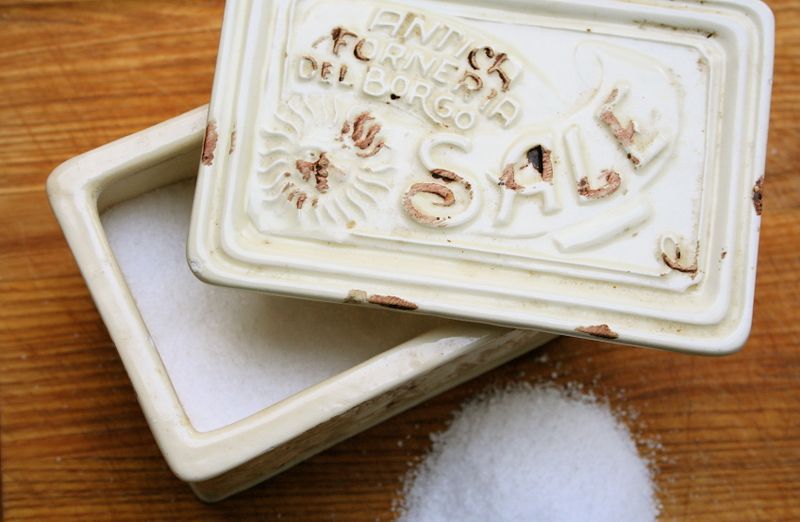
 A few months ago I asked my friend Kimberly if she would mind doing a guest post on my blog. You see, this friend Kimberly of mine is a graduate of the Culinary Institute of America and I have her to thank for my conversion to kosher salt about 7 years ago. I haven't bought table salt since. You see, I'm kind of passionate about kosher salt. I'll never go back. I even bought us these matching ceramic salt boxes to house our kosher salt. Mine is always within arms reach, right next to the oven.
So without further ado, I introduce Kimberly!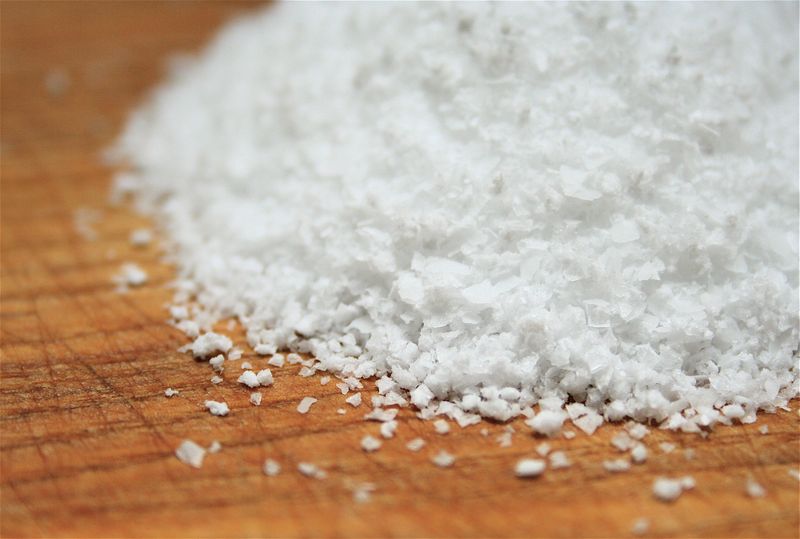
While all salts are technically kosher, they are not all KOSHER salt! What is the difference between table salt and kosher salt?
All salt is sodium chloride. The difference between the salt options we have in the store starts with where they were mined/harvested and ends with the refining process.
Diamond Crystal is my favorite kind of kosher salt. The sodium chloride is blown into a stainless steel box and permitted to dry and form crystals. These crystals are scraped off the box, and the process is finished. Giving you lovely large salt crystals with no additional ingredients. (Some kosher salts, like Morton’s, add sodium ferrocyanide to help the salt not clump. I notice a flavor difference in my food – and only use Diamond Crystal. )
Table salt is highly refined and contains ingredients like iodine and some sort of free-flow agent, like the sodium ferrocyanide in Morton’s kosher salt. This results in a salt that consists of singular grains and doesn’t clump. Perfect, I suppose, for a saltshaker. (I don’t own a saltshaker!)
Pure salt is a flavor enhancer. Added just the right amount, you will be able to taste all the flavors in your food, without tasting salt. This, clearly, is the goal. Table salt doesn’t allow you to achieve this goal. The iodine flavor is bitter and strong, and will dominate the flavor profile of your meal.
I do a simple experiment in my cooking classes to demonstrate this. I boil 1 carrot, ½ onion and 1 celery stalk in 1 quart of water for 45 minutes to an hour. I then strain it, and add 1 pinch of salt to the first serving, 2 pinches to the second, 3 pinches to the third… people find it hard to believe the only difference in the three broths is the amount of kosher salt. Then I do the same with the table salt. You never achieve the same flavor. You end up with salty, flavorless broth.
If you use kosher salt with your baking, keep in mind that 1 t. of table salt and 1 t. of kosher salt will not yield the same amount of salt. Kosher salt contains more air due to the unrefined crystal structure. Baking is chemistry, and you have to have enough of ‘A’ and ‘B’ to get a proper ‘C’. Most boxes will tell you the volume difference between kosher and table salt. Ideally, however, you could simply weigh your ingredients – as the volume doesn’t change the weight.
Some chefs/bakers don’t like to use kosher salt in their baking items because it doesn’t always fully dissolve because of its unique shape. If your recipe has limited amounts of liquid, you might want to stick with table salt. I simply make sure I brake up the salt with my hands when I add it. I haven’t
experienced a problem. Just play with it, and you’ll know what is best for your cooking/baking habits.
Have you ever been to a high-end restaurant that offers you a saltshaker on the table? No! The chef wants you to taste the food as they have prepared it. Then, if you want salt, and you can ask for it, they bring you a small bowl of kosher salt. The bottom line is that salt can either enhance or ruin the flavor
of your food.
I have had my comments turned off since March, but will open them up here so if you have any questions for Kimberly, ask away!


 Site Title
Leave a reply to Mark Bitterman Cancel reply